
Что такое гидравлический лифт?
Гидравлические лифты, как следует из названия, представляют собой тип лифтовой системы, в которой в качестве привода используется гидравлическая жидкость.
Как работают гидравлические лифты
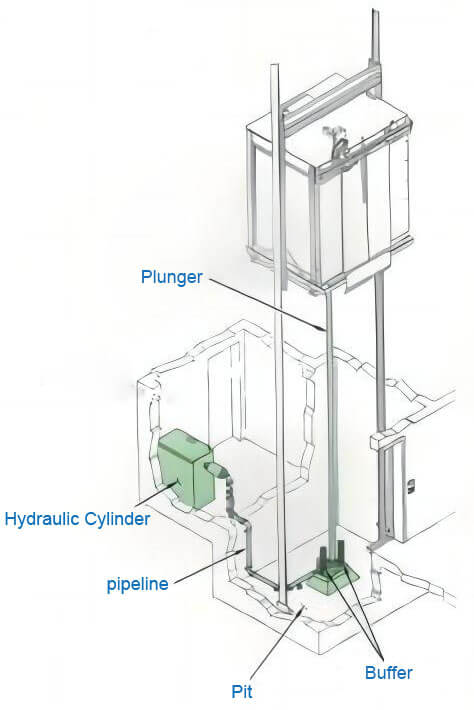
Конструкция гидравлического лифта относительно проста и состоит из гидравлической насосной станции, гидравлического цилиндра, основных компонентов системы управления.
Когда лифт запускается, насосная станция вырабатывает масло под высоким давлением, которое толкает поршень в цилиндре, заставляя его двигаться вверх и вниз, тем самым поднимая и опуская лифт. Этот процесс, подобно течению воды сверху вниз, подчиняется основным законам механики жидкости.
Types of Hydraulic Elevators
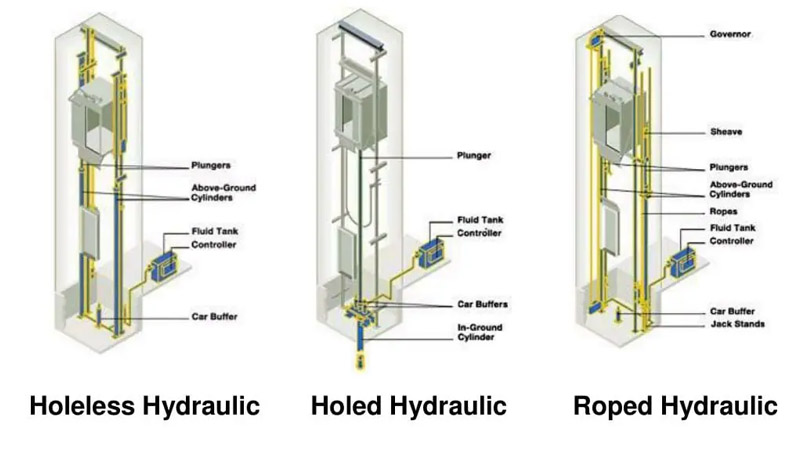
Hydraulic elevators come in three main types: holed hydraulic, holeless hydraulic, and roped hydraulic.
Holed Hydraulic Elevators
This type of hydraulic elevator is sometimes referred to as a direct-acting lift. Here, the hydraulic cylinders are driven into the ground to a depth that is equal to the height the elevator will rise. Once this is done, the elevator car is then mounted on a piston that travels inside of the cylinder. When hydraulic fluid is released into the cylinder through a valve, the car would rise. When the fluid returns to the reservoir, the car would then descend.
Holeless Hydraulic
This type of elevator is used in existing buildings or in areas with bedrock, a high water table, or unstable soil conditions locations. This is because drilling isn’t required for this kind of elevator. So, instead of having a cylinder buried underground, this kind of hydraulic elevator uses hydraulic jacks located above ground level. These jacks are often placed on either side of the elevator car. The principle for ascending and descending here is the same as that of the holed hydraulic elevator.
Roped Hydraulic
Roped hydraulic elevators use a combination of cables and a piston attached to a sheave to lift the elevator car. This allows for a smooth riding experience without the need to dig a deep hole in the ground.
Here, the hydraulic jack is positioned in the hoistway between the rails, with a pulley attached to its top. Also, two hoisting cables connect the system: one end is attached to the elevator cab, and the other end is secured to a fixed point at the base of the rails. Then, the controller and hydraulic pump are located in a nearby machine room. This type of elevator requires only a shallow pit.
The roped hydraulic system is also designed to use the pulley to give it a 2:1 movement ratio. This means that for every 1 foot that the jack moves, the cab moves 2 feet. This is how the unit can operate without digging a deep hole for the hydraulic jack. Also, roped hydraulic systems require a governor because the rope is holding the car up, and there is a risk of the car free-falling if the rope breaks.
What Buildings Do Hydraulic Elevators Work Best?
Hydraulic elevators are mainly suitable for low and mid-rise buildings (usually 2 to 8 floors), but not for high-rise buildings. The main reasons are:
- Hydraulic elevators consume high energy, there is no balanced counterweight in hydraulic elevators, the full weight of the car needs to be maintained by hydraulic pumps, and the long-term running cost is much higher than the energy-saving traction power
- The stroke of the hydraulic cylinder is limited, and a complex multi-stage cylinder design is required after exceeding 20 meters, which increases the maintenance cost;
- the hydraulic oil is greatly affected by temperature and is prone to fluctuation and leakage problems during long stroke operation, affecting smoothness;
Advantages of Hydraulic Elevator
If you’re looking at installing a hydraulic elevator in your building, here are some of the advantages you stand to gain from doing it:
1. Hydraulic elevators have a higher load capacity and are suitable for larger loads.
2. Easy to install and maintain.
3. No need for a machine room, saving building space.
Disadvantage of Hydraulic Elevator
However, installing a hydraulic elevator also comes with some disadvantages:
1. Its use is limited to just low and mid-rise buildings.
2. The motor and pump make noise when working
3. These elevators can also be affected negatively by things like extreme temperatures and oil contaminants.
4. The hydraulic oil can also leak into an aquifer which can cause serious problems for the environment. This is usually seen in older hydraulic elevators.
Hydraulic Elevator Cost
The cost of purchasing and installing a hydraulic elevator is often dependent on the height of your building.
A hydraulic elevator for a two-story building can cost between $4,000 – $10,000. For a four-story building, a hydraulic elevator can cost from $6,000 to $13,000. While for a five-story building, your estimated cost can go between $8,000 to $15,000.
As a professional elevator manufacturer, Dazen can install new hydraulic elevators for your building, or modernize or repair your existing hydraulic system, contact us today!
Hydraulic Elevator FAQs
Does a hydraulic elevator need a machine room?
Hydraulic elevators do not require a separate machine room and the drive system is generally installed at the bottom of the shaft. Building space can be effectively utilized
Are hydraulic elevators suitable for home use?
Hydraulic elevators have noise and oil leaks and are very inconvenient to clean up, so they are generally not recommended for use in the home environment
What places are hydraulic elevators suitable for?
Hydraulic elevators are suitable for use in places with large load requirements, slow speed and short range, such as factories, garages and other low-rise buildings.